Friday, February 11, 2022

#52Ancestors - Favorite Find

#52Ancestors 

FAVORITE FIND

    Included with some possessions that were given me from my grandfather, Hudson Webb, was a letter on embossed note paper dated December 15-97 (1897).  There are no names included but Grandpa referred to the letter in a history of his ancestors and states that it was from his mother, Annie, to her mother, Elizabeth. It has been kept between pages in a Temple Record book of Elizabeth's.  The colors are bright and it is in remarkable condition.  The folds are starting to wear.  The purple ink matches the purple flowers on the embossing -  was that intentional?

    The inside reads:  

    I am sending a pair of shoes, I hope it will not be unpleasant news, And I hope they will always keep you warm, That you from cold floors will never take harm.  Use them in all weather, rain or fine, For they were made for use, not as ornaments to shine, I trust there will be no unpleasant meetings, Between the two, but kindly Greetings.

    Many, many, happy returns of the day, God grant the future before you lay, Unclouded and bright as a summers day.  That all sorrow and pain from you may depart, and rest and all happiness fill your heart. God bless sand strengthen you all your days and keep you sheltered under his wing always.  


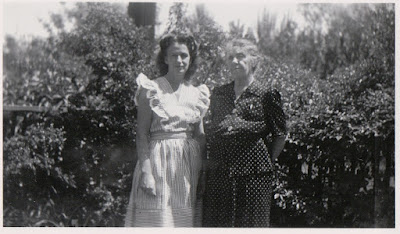
Sarah (Annie) with mother Elizabeth
Sarah (Annie) with mother Elizabeth 

Sunday, February 6, 2022

#52Ancestors - Week 9 (albeit a year late)


FOUNDATIONS

From A History of John Burt Jr. 1853-1926 by Margaret Hazel Burt Tensmeyer and Carolyn Tensmeyer Andersen.

Though he was engaged in building railroad, when Father (John Burt Jr.) could be in Salt Lake City, he courted a lovely young lady with hazel or dark grey eyes and golden hair.  They married on 6 Nov 1879.  Father took his bride to live in a new home he had built for her of adobe, next door to his father’s home on 3rd West Street.    

When the BURT and CONDIE Construction Company contracted railroad building up the Spanish Fork Canyon during 1884 and 1885, Father moved his family to Spanish Fork Town so that they would be near his work.  A small home was rented from Alfred Reese, who was the father-in-law of Adam Burt, father’s younger brother.  After returning to Salt Lake for a brief time, Father disposed of his property in Salt Lake City and moved his family permanently to a small two room house in the Palmyra District in Utah County.  The house was situated on a knoll, as was the small shed for horses.  The house was situated on a knoll, as was the small shed for horses.  The place had a tree or two, was not fenced and there were a few patches of alfalfa.  This needed much care, cultivation and water to yield a small crop.  The property in general was quite undeveloped and a great deal of clearing the land of grease-woods, saleratus and saltgrass had to be done.  It was rather low and ponds of water in the northern part had to be drained.  It had a good water-right for irrigation but it meant hard work and patience before it eventually yielded good crops.  Deep ditches were dug to carry away the alkali and salt water that formed when it rained or was irrigated.  Renewing the old irrigation ditches and making new ones to take care of the cleared off land kept the men folks busy.  It seemed the water turn came frequently and must be used to the best advantage.  It was a never ending job of grubbing and stacking of the pitch-filled brush.  When a large stack was dry enough, it was used in the stoves for firewood.  It gave a great deal of heat so sometimes we roasted corn and potatoes on a stack for a treat. 

Not far from the house was a clay bed and as Father knew the art of molding this substance into blocks, he made molds for blocks.  With these blocks he made a large room some 16 by 10 feet in size.  It was cool in summer and warm in the winter and made a lovely addition to the house.  A milk house was also built of adobe where the water ran through the wall into a trough and out the other end.  This was used as a refrigerator for milk, butter, eggs, meat and fresh fruit.

The home was five miles from the town of Spanish Fork where supplies were bought and the mailed picked up.  We were some distance from any neighbors and almost two miles from the Little Red School house where we went to school. 

In 1903 the original two rooms were torn down and the house from my mother’s brother’s property was moved to give us three large bedrooms.  This gave us ample room and many improvements were made to make it even more comfortable.  A defective flue caused a fire that destroyed the home and most of its contents in the spring of 1908.  This was such a tragedy to witness – our lovely home and precious belongings went up in flames.  Even the trees were blackened and barren from the heat.  A strong wind from the north fanned the flames and when we returned at night only the walls of the adobe room were standing, bleak and cold.  The remainder of the home was an ash heap. 

Mother, Samuel and myself and the two little girls were eating our lunch on that beautiful spring day in April.  The door to the kitchen was open and we smelled smoke.  The door to the front room was opened to investigate and the draft fanned the embers into flames.  In seconds the roof was on fire.  Our neighbors saw the fire and came to help but it was too late. 

A fund was raised by our friends to help replace the house.  Workmen swarmed all over the place to clear away the debris and start the new building.  By fall, it was ready to move into.  The new home did not have the room we had before and part was not finished but we were grateful to be back home again.  It took several years to replace clothing, bedding, dishes, pans and furniture. 

This was the prompt from Amy Johnson Crow the first week in 2022.  I have been putting off doing this blogpost since that time.  I knew that I wanted to do something about the construction company and John Burt Jr. but just never took the time.  As I read from the history, I had forgotten about the house fire.  I then thought that I needed to add current content to the blogpost to pull two stories together.

On Friday, January 14, 2022, I was at my son’s home in Utah County visiting for a few days.  I received a phone call from my brother-in-law stating that he couldn’t get a hold of my husband.  He told me that he was on his way home from work because he got a call that his house had burned down (in Kearns, Utah).  I told him I was on my way and would see him there.  I rushed there and this is what I found:


It was a total loss.  And it was heartbreaking.  My father-in-law had been living there with him at the time so they are both homeless.  They will rebuild on the foundation that is there.  Because of the over-priced and short-on-inventory housing market in the valley, four weeks later it continues to be difficult to find temporary housing.  It would be nice if this could be repeated from 1908:  A fund was raised by our friends to help replace the house.  Workmen swarmed all over the place to clear away the debris and start the new building.  By fall, it was ready to move into.  For all of our technology and advancements, community, family and friends remain the most important foundation in our lives.


Saturday, March 13, 2021

#52 Ancestors - Week 8 - Power

I sit in my house today as the snow melts from a late winter, much-needed snow storm.  A click of a button and the furnace comes on, I sit at the computer to type a blog post, I use my phone to catch up on the grandkids' lives, flip a switch for lights, hop in the car to pop into the grocery store for groceries, turn a dial to light up the stove to make dinner, stop at the sink to wash my hands in instant warm water, and the list goes on.  Is there anything in my day that doesn't involve instant power?  

From my Father's history:

Approximately 1942 - In Lyman [Wayne County, Utah] my grandmother's sister (her name was Athalia Van Dyke), and her daughter, LaPreal, had a cow so they could have fresh milk.  They had a machine that you worked by hand that was called a separator that was used to separate the cream from the milk.  I remember LaPreal would use the cream to make the best, richest chocolate cake I had ever eaten.  There wasn't any running water in the houses in this area.  There was a pump at the kitchen sink that you pumped by hand to bring the water up from the well.  The stove you cooked with used coal.  No central heating.  A small pot-bellied stove was in the front room that furnished the heat.  To take a bath you had to heat water on the kitchen stove and fill a small tub you would put in the middle of the kitchen.  A shower was unheard of.  They did have a phone - 10 party line.  You would have to lift the receiver, turn a small crank, wait for the operator to answer and give her the number of the party you wanted to call.  Everyone on the party line could listen in to your conversation if they wanted to.  Not many secrets in small towns in those days. 

When I turned 14 [1944], I was old enough to get a work permit so I could get a job.  There were no fast food places in those days.  There was a bowling alley across the street from the Jr. High School and I got a job there setting pins after school, at nights and on weekends.  Automatic pin setting machines were not invented yet, all the pins had to be set by hand by boys or men who sat on a board at the end of the alley and after a person had thrown their ball would pick up the pins and put them in a rack.  After the second ball, pick up the rest of the pins.  Then you would have to push the rack down to set the pins correctly.  I made 7 cents for every game that I set pins for.  On weekends if I made $5-$7 working all day long I was happy.  

1948 - I bought my first car.  A 1936 Ford two door sedan.  It ran okay, but the battery would go dead after a few days driving.  I would just have it charged and go on my merry way.  One time I had a carload of friends and we decided to go to Evanston, Wyoming [from Salt Lake City].  It was late in the afternoon when we left and when we got there it was dark.  Naturally, the battery went dead.  I had it quick charged and we started home.  We were a short ways out of Evanston and the lights became so dim I could hardly see the road, but I could make out the center line.  This was before freeways.  I had a flashlight and one of the kids held it out the passenger side window and shined the light in front of the car so I could see better, but not much better.  A greyhound bus passed me and I decided I would follow it as close as possible.  It was a wild ride trying to keep up with the bus, especially going down Parleys Canyon.  The canyon was just a two lane narrow road at that time, even though it was the major east/west Highway 40 going east out of Salt Lake.  Obviously, I survived that experience.  Teenagers do stupid things at times.  (I realized later that adults aren't too smart at times either.)  

Thursday, February 18, 2021

#52Ancestors - Week 7 - Unusual Source - Danish military records

A few weeks ago, I took a Danish research class offered virtually through the Riverton Family History Library.  It was three classes: (1) Introduction to Danish research and parish records; (2) Using Danish census records; and (3) Danish military records.  It was fascinating to see how much was available when I had always just thought I would never be able to find anything for my Danish ancestors.  

I found the Danish military records to be fascinating.  The military rolls started in 1789.  Males were registered at the time of birth and would stay on the rolls until age 34.  These rolls continued until 1860.  A complete roll was taken every 3 years with a supplement for other years.  Notations were made when an individual moved and where he moved to and the entries always included their father's name.  

Here is what I found for my great-great grandfather Peter Christian Peterson born in Mygdal, Hjorring, Denmark in 1834.  

PETER CHRISTIAN PETERSON – born 5 Jun 1834 Lilholt, Mygdal, Hjorring, Denmark

                Hjorring (Mygdal 11) 1835 Page 14, #239, Mygdal, 4 Jun 1834

                Hjorring (Mygdal 11) 1836 Page 115, 239/194, Mygdal, Age 1

                Hjorring (Mygdal 11) 1839 page 115, 194/168, Mygdal, Age 4

                Hjorring (Mygdal 11) 1842 page 117, 168/142, Mygdal Age 7

                Hjorring (Mygdal 11) 1844 page 130, 142/117, Mygdal age 10

                Hjorring (Mygdal 11) 1847 page 132, 117/93, (crossed off)


And then I became stuck because I couldn't read the notations of where he moved to.

It was so interesting that each entry would list the old number and the new number so you would know where to look for the next year.  I can't wrap my brain around how they would do this.  

I am grateful for those who have expertise in these areas that so willingly share their knowledge with others.  I hope to get back in these records in the near future and see what else I can find.  


#52 Ancestors - Week 6 - Valentines

I thought with this one I would find as many stories as I could about how a couple met.  I'll work backwards.

Brock and Angie - He was deployed in the Navy to Iloilo, Philippines and used the Tinder dating app while he was there and met Angie.

Brad and Erin - They had a mutual friend and met at a group activity.

Bryce and Alicia - He was her roomate's home teacher in their BYU student ward and were in the same FHE group. 

Scott and Bobbi - Scott was a wrestler and I was a wrestlerette at Jordan High School in 1978.  

Ray and Maida - from Mom's history:  "He had given me a ride home from school in October.  I didn't know him, but he lived in Highland Park Ward, too.  He had joined the Air Force not long after we moved into the ward, but I do remember him in church when he came home on leave.  He would sit on the back row with his uncle, Jay Peterson, who was as dark as Ray was light.  (They were married one year later after the ride home.)

Ray and Wanda - from Dad's history:  "I am an only child.  My parents were divorced when I was an infant.  I believe my mother was pregnant before she was married, but she won't talk about it."

Hudson and Maida - from Hudson's audio history:  I had an opportunity to go to Daynes-Beebe, it was the big music business in the city.  Maida worked there, we worked side by side.  She was actually my boss.  And we dated.  Although not seriously.  I remember the first date I took her on.  We went to Wandamer, that was where the golf course is now, it is located at 7th East and 27th South [Salt Lake].  They had a lake there and on the lake they had a stage... I took her there and she got out of the car and he stepped in a ditch of running water.  Oh, I was embarrassed to death. 

Heber Peterson and Lovina Short - "For several years Lovina worked at the Glenwood [Sevier County, Utah] store and then she fell in love with a returned  missionary - Heber Peterson."  Heber owned a ranch at Grass Valley, a section of country between Glenwood and Fishlake.  

Charles Cottrell Jr. and Erminnie Layton - His mission journal begins with leaving his home in Kaysville for the depot and stopping at the home of Mr. Charles Layton (Erminnie's father) and wishing them all goodbye. 

John Burt Jr. and Mary Etta Seddon - "Though he was engaged in building railroads, when Father could be in Salt Lake City, he courted a lovely young lady with hazel or dark grey eyes and golden hair.  She lived in the 6th Ward - a few blocks away on 3rd West and 6th South St [Salt Lake City] and was employed by the Deseret Book Binding Company."    

This was fun exploring.  I need to do more and add to this when I can.  

Friday, February 5, 2021

#52Ancestors - Week 5 - 3 GENERATIONS OF SERVING WARE

The prompt this week was In the Kitchen. I thought about how I have become the repository for all things family history.  When someone wants to get rid of something that belonged to an ancestor, most likely I will say, "No, give it to me."  That's how I have ended up with three generations of china sets.  

I registered for china and silver at ZCMI in Salt Lake City when I was married in 1981.  We received place settings for 8, a few serving dishes and just a couple pieces of silver.  I should use it more than I do.  Mom was never the type to give advice and no one else mentioned to me that if I chose a color like blue with flowers it would be difficult to use at Christmas, etc.  I probably would have been too stubborn to listen anyway.


When my mother moved from her home into a smaller downstairs apartment, she had nowhere to store her china and glassware so I gladly took it.  I think I have a service of 8 along with some parfait dishes.  I'll update with info of when she acquired it and where.  Mom had received this set from her mother-in-law in about 1960 when they moved into their home in White City. 


I received my maternal grandmother's set (Maida Hope Cottrell Webb) either when they cleaned out her house after her death or when my mother moved and she had been storing it.  I couldn't let it be given away.  There is at least a service for 8 and is in such good condition.  She was married in 1928.  I'm not sure how old the china is.


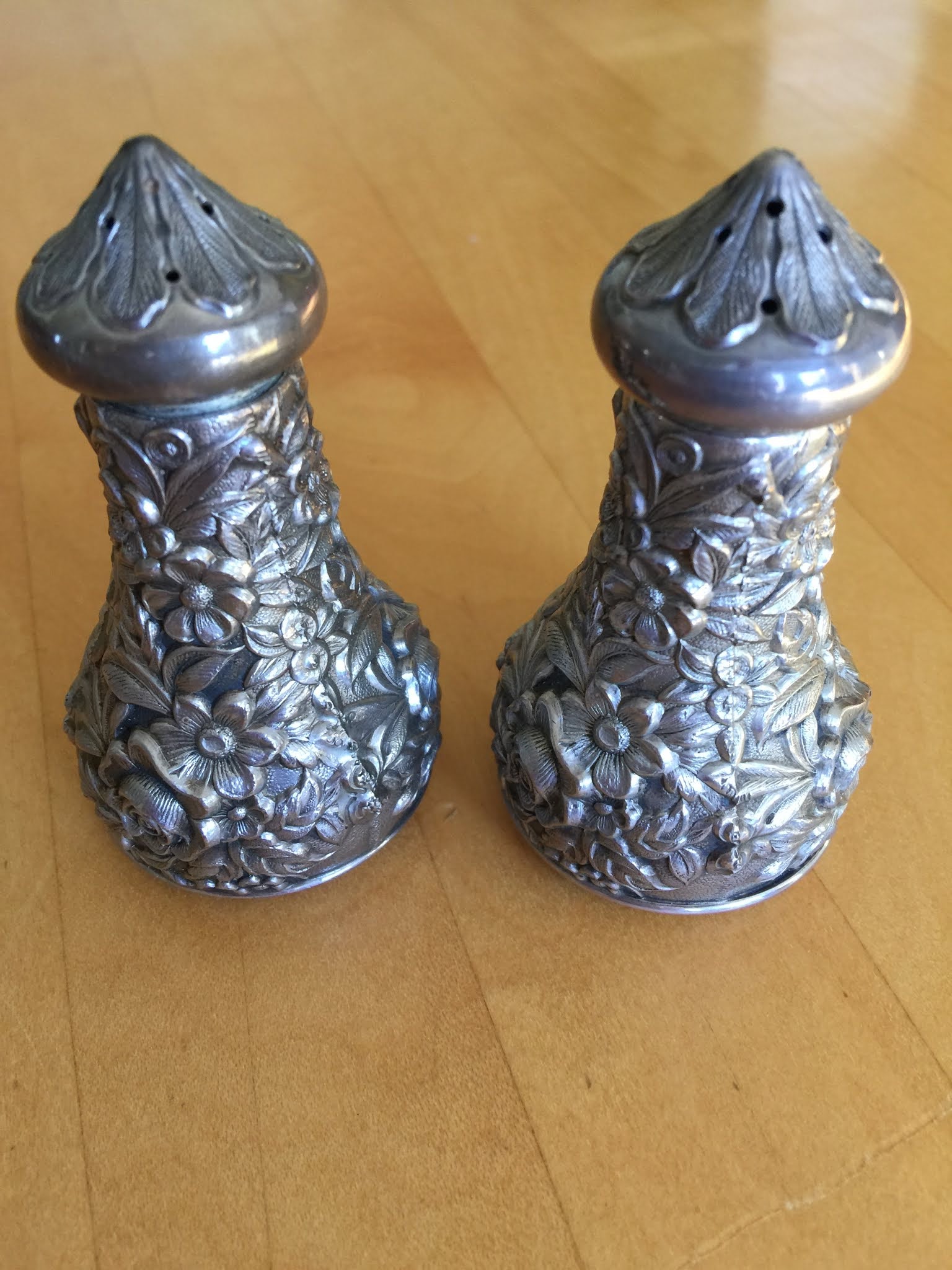
Somewhere in the last couple of decades I gladly took the silver set of my paternal grandmother Wanda Peterson Kincaid.  I think my parents had it but never used it and I couldn't let it be given away.  My parents had received it from my dad's Aunt Alice somewhere in the 80s.  Wanda had given it to her sister Alice when Wanda moved from the area in about 1966.  It's still in the flannel storage pockets and has the label "Leyson-Pearsall", a jewelry company in Salt Lake City.  There is a service for 8 plus many serving pieces and a salt and pepper shaker.  On Thanksgiving 2019 since we had only adults there, we set out Grandma Webb's white with gold china, her goblets and Wanda's silver set.  All were willing to shine the silver beforehand and hand wash all pieces afterwards.  It was so fun.  One item we found was the tiny matchbox shown in the picture below.  I had never seen it before - it was tucked in one of the storage pockets.  It still has a full set of matches.  


I love all of my china/silver sets and need to make an effort to use it more often.  I have a couple of daughters-in-law that may be willing to take some of it when I am gone, but I'm not sure where it will all end up when we have to downsize or when I am gone.  I hope someone can appreciate it as much as I do.

Sunday, January 31, 2021

#52Ancestors - Week 4 FAVORITE PHOTO

This was a fun yet difficult challenge.  How do you pick a favorite photo?  I am using my husband's favorite and one of my favorites.

This is a picture of my grandfather, Henry Hudson Webb, while serving a mission for the Church of Jesus Christ of Latter-day Saints in the Swiss-Germany mission.  He left a new wife in Utah in October 1928 and returned home in February 1931.  Using Google translate, it appears they are in front of a church building and possibly a church distribution store.  I also need to upload this into FamilySearch and see if I can possibly find out who these other two men are and share it on their pages.  


What's hard to wrap my brain around is this photo is almost 100 years old and yet I knew my grandfather very well.  Which really means that I am getting old and my baby pictures are now considered antiques.

This next one is my husband's favorite and I can see why. This was in 2009.  We were together as a family for the first time in four years.  My oldest son (in the middle) left for a two-year church mission in 2005.  My middle son (on the right) left for his mission in 2007, three weeks before the first returned home.  This photo is at the airport in 2009 when he returned home.  Twenty-one years later it still brings me great joy when on rare occasions we are able to be all together.